Transform decades-old systems into future-ready applications in months, not years
Transform decades-old systems into future-ready applications in months, not years

Opteamix delivers human-led, AI-powered legacy application modernization services. Our engineers use Generative and Agentic AI to analyze legacy code, extract its business logic, and rebuild your applications on modern, cloud-ready technology stacks, all without disrupting day-to-day operations.
By delivering on leading AI platforms such as Claude, Gemini, and GitHub Copilot, we modernize your systems faster and with less risk, giving you a clear path to applications built for where your business is headed.
A McKinsey article reports that nearly 70% of the software used by Fortune 500 companies is more than 20 years old. Systems that once powered growth now limit innovation, increasing technical debt, fragmenting architectures, and locking critical business logic in code that few engineers fully understand.
Traditional modernization approaches often make the problem worse. They are slow, costly, and dependent on a shrinking pool of legacy specialists. Months are spent analyzing systems before transformation even begins, causing initiatives to stall, exceed budgets, or fail to move forward.
Organizations face intertwined challenges spanning technology, people, and strategy.
Outdated frameworks and architecture, tightly coupled systems, and aging databases make modernization fragile, slow, and unpredictable.
Legacy expertise is disappearing, leaving enterprises dependent on a small, costly, and shrinking pool of specialists.
Decades of undocumented logic and tribal knowledge obscure how these systems work and what could break if they change.
Enterprise systems cannot tolerate downtime, as any disruption affects operations, customer satisfaction, and revenue.
Unsupported platforms and unpatched code increase security vulnerabilities and heighten regulatory compliance risks.
The wrong modernization approach, sequence, or target stack can derail the entire organization.
Modernization doesn’t have to mean a costly, high-risk rewrite. Managing this transition requires a structured, low-risk roadmap that retains embedded business rules without disrupting ongoing operations.
Opteamix modernizes legacy applications by combining the speed and scale of AI with our engineers’ expert judgment. Generative and Agentic AI handle code analysis, business logic extraction, code generation, and testing, while our engineers validate every output to ensure accuracy, traceability, and production readiness. Our approach is designed to manage the complexity of legacy systems while preserving critical business logic and ensuring continuity. The result is faster, lower-risk modernization delivered in months, not years.
AI accelerates every phase, while experienced engineers direct and validate each output, ensuring enterprise-grade accuracy and control.
We deliver on leading AI platforms, including Claude, Gemini, and GitHub Copilot, selecting the one that best aligns with your requirements, technology, and security standards.
Decades of embedded rules and undocumented logic are extracted, documented, and validated with your subject-matter experts before the transformation begins.
Every requirement maps to the legacy source and the modernized code, creating a fully auditable transformation path with phased, module-level delivery.
These principles come to life through Opteamix’s A • D • A • P • T framework (Assess, Decode, Architect, Produce, and Transition), our structured, five-phase modernization framework, refined through enterprise engagements.
We analyze your legacy portfolio, map dependencies, and define the modernization roadmap, including sequencing, target architecture, and business case. You start with a clear, evidence-based view of what to modernize and the value it will deliver.
AI extracts the business logic, workflows, and rules embedded in your legacy code and translates them into clear, traceable requirements. Your subject-matter experts then validate and refine these requirements, recovering decades of institutional knowledge, preserving what works, and flagging what no longer serves the business.
With the logic decoded, our domain experts design the target state, deciding what to preserve, what to enhance, and where to build new AI-enabled capabilities. This is where modernization becomes transformation. We redesign workflows and architecture for today’s business, built for where you’re going, not where you’ve been.
AI generates production-ready, full-stack code for your target stack, including backend, frontend, database schemas, and integrations, modernizing functionality along the way. Every output undergoes AI-driven testing and an engineer-led review to confirm functional equivalence before anything reaches production.
We deploy via your DevOps pipelines, validate performance in production, and continue as your modernization partner, optimizing, scaling, and extending the system with new capabilities as your business evolves. We also drive user adoption and ensure the realization of business value through structured enablement, training, and ongoing support.
Opteamix offers end-to-end legacy application modernization services aligned with our A • D • A • P • T framework. Engage them as a complete program or adopt them individually, based on where you are in your modernization journey. Every service is delivered through our human-led, AI-powered approach on the AI platforms your enterprise trusts.
Define what to modernize, how to do it, and the value it will deliver.
Recover and preserve critical business knowledge embedded in legacy systems.
Don't just modernize what exists, but improve how the business works.
Transform legacy systems into modern, scalable, and cloud-ready applications.
Ensure the modernized system performs reliably and meets business expectations.
Ensure modernized systems are not just deployed but actively used and adopted, delivering measurable business value.
Enable long-term scalability, resilience, and continuous improvement.
A Modernization Assessment is the lowest-risk first step most clients take.
Opteamix modernizes a wide range of legacy systems, applications, and technology environments that continue to power enterprise operations. Our human-led, AI-powered approach enables us to work across diverse architectures, languages, and platforms, helping enterprises transform even the most complex legacy application landscapes.
COBOL, RPG, PL/I, Natural, JCL, and other mainframe-era technologies modernized into cloud-native applications while preserving decades of embedded business rules.
VB6, PowerBuilder, Delphi, Oracle Forms, MS Access, FoxPro, and similar client-server systems, re-engineered into modern web and cloud applications.
Classic ASP, legacy .NET Framework, older Java (J2EE/EJB), Struts, ColdFusion, and PHP monoliths upgraded to current frameworks and re-architected for scalability.
Most legacy environments span multiple generations of technology. We modernize across diverse legacy environments, architectures, and platforms to align with your business needs. Talk to us about your stack to understand what’s possible.
Opteamix takes a platform-agnostic approach to legacy modernization, combining leading AI models, cloud platforms, and engineering tools to deliver scalable, future-ready solutions. We integrate seamlessly with your existing technology landscape and select the right mix of platforms to optimize performance, cost, and control.





We orchestrate leading AI models from OpenAI, Anthropic, Google, Microsoft, and others to optimize code analysis, transformation, and testing. We apply different models to different stages of modernization to improve accuracy, speed, and cost efficiency.



AWS, Microsoft Azure, and Google Cloud target environments for modernized, cloud-native applications, aligned with your existing cloud strategy and enterprise agreements. We design for hybrid and multi-cloud architectures, enabling scalability, resilience, and long-term flexibility.

Java, .NET, Python, Angular, React, and other modern tech stacks for microservices, containerized, and API-first architectures, integrated with your DevOps toolchain and CI/CD pipelines.
Representative Ecosystem: Tools and platforms are selected based on workload requirements, scalability, security, and enterprise architecture considerations.
Platform or tool choice is an engineering decision, not a default. As part of every engagement, we assess which AI platform or combination best fits your legacy stack, target architecture, security requirements, and commercial agreements.
Different platforms have distinct strengths across languages, codebase scale, and transformation tasks; our job is to understand those differences and put them to work for you. As platforms evolve, your modernization approach evolves with them without re-platforming or lock-in.
Opteamix’s A • D • A • P • T framework consistently delivers measurable business outcomes that accelerate transformation while reducing risk and cost. By combining Opteamix’s human-led, AI-powered approach, we enable enterprises to modernize at scale with greater speed, accuracy, and confidence.
Based on Opteamix’s implementation benchmarks, our legacy modernization services deliver the following results:




We deliver modernization outcomes that are faster, more predictable, and aligned to your business priorities. Every engagement begins with a business case grounded in your actual codebase. Request a Modernization Assessment to see what these numbers look like for your application portfolio.
With decades of enterprise engineering experience, Opteamix blends AI innovation with deep modernization expertise. Our teams bring a proven understanding of legacy systems and strong technical craftsmanship to every engagement, ensuring modernization is not just faster, but smarter and lower risk.
We go beyond rewriting code. We help you design a legacy modernization roadmap that’s secure, scalable, and aligned with your business priorities. Backed by multi-agent AI platforms, DevOps integration, and a strong engineering culture, Opteamix enables organizations to move confidently from outdated architectures to future-ready systems.
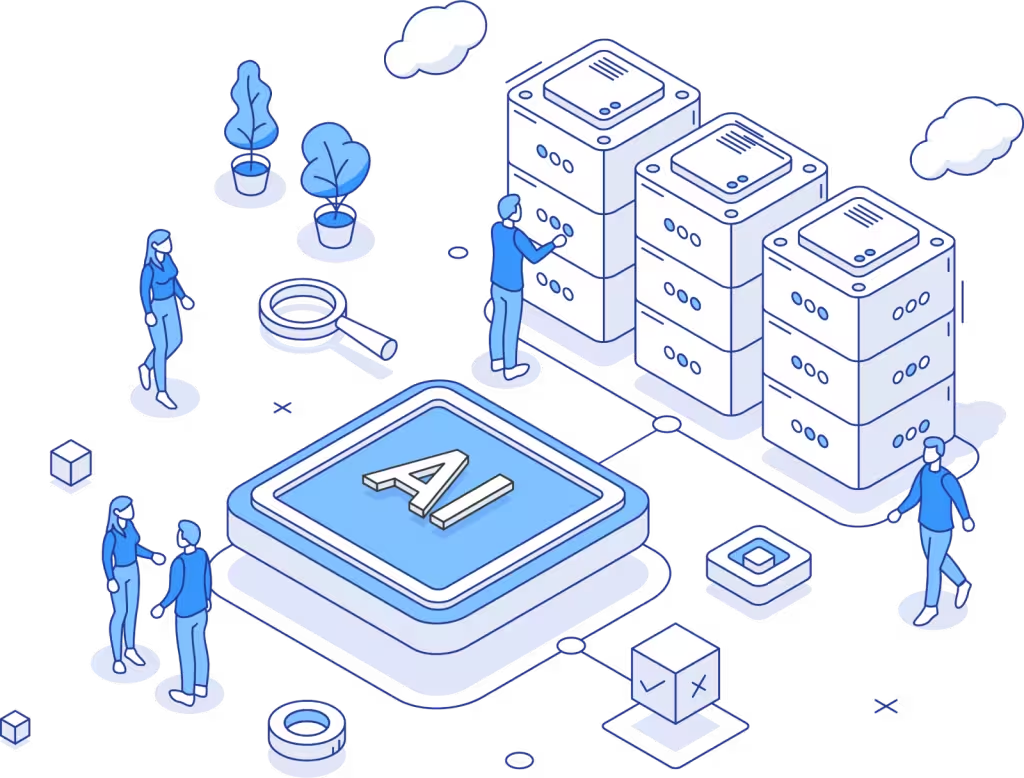
Experienced engineers lead every engagement. While AI accelerates the work, accountability, validation, and judgment remain with people. Nothing reaches production on AI’s word alone.
We deliver on Claude, Gemini, GitHub Copilot, and the platforms your enterprise already trusts, selecting based on your standards rather than our convenience. As the AI landscape evolves, your modernization strategy evolves with it.
Proven delivery standards, secure development practices, and modernization accelerators refined through enterprise engagements over the last 14+ years.
We don’t just rebuild what exists. Domain experts and business analysts challenge legacy workflows, close functional gaps, and embed AI-enabled capabilities into the modernized system.
From assessment through logic extraction, re-engineering, validation, and post-go-live support, one accountable partner spans the entire journey, not a handoff chain.
We measure success by your long-term outcomes, not project sign-offs. Knowledge transfer, team enablement, and transparent delivery are built into how we work.
The AI platforms are available to everyone. The judgment that turns them into production-ready systems is the one you’re making.
Explore our latest thinking and insights on AI-powered legacy modernization. Practical perspectives from the teams doing the work.
Explore our success stories, brochures and other resources on Human-led, AI-powered legacy modernization.
Let Opteamix and AI handle the heavy lifting, so your teams can focus on building the future with confidence.
Get answers to common questions about AI-powered legacy modernization, including approach, timelines, risks, and outcomes.
Legacy application modernization transforms outdated systems into modern, scalable, and cloud-ready applications. This includes refactoring, re-platforming, or rebuilding applications while preserving critical business logic.
AI-powered legacy application modernization uses artificial intelligence, including large language models (LLMs) and agentic AI, to analyze, document, and transform outdated legacy systems into modern, maintainable, and scalable architectures. AI automates the most labor-intensive phases, such as code analysis, business logic extraction, code generation, and testing, while engineers validate every output.
Modernization improves performance, security, and scalability. It reduces technical debt, removes dependence on scarce legacy skills, enables integration with modern platforms and AI capabilities, improves the user experience, and lowers operational costs. These capabilities are essential for digital transformation and business agility. Enterprises typically achieve faster time-to-market, reduced technical debt, lower maintenance costs, improved scalability, and enhanced agility.
Our services span mainframe technologies (COBOL, RPG, PL/I), client-server applications (VB6, PowerBuilder, Delphi, Oracle Forms), aging web and enterprise stacks (Classic ASP, legacy .NET, older Java), and monolithic architectures and integration platforms, transforming them into cloud-ready, modular architectures.
No. Migration moves applications to new infrastructure (such as the cloud) largely as-is. Modernization upgrades the architecture, code, and functionality. Opteamix delivers both, but our focus is on genuine modernization, systems that are improved, not just relocated. Modernization often involves migrating applications to cloud platforms and adopting cloud-native architectures to improve scalability and resilience.
Yes. Modernizing a legacy application is often the right time to replace dated, hard-to-use interfaces, such as green screens, rigid desktop forms, and the lack of mobile access, with modern, responsive, and intuitive experiences. Our experienced UI/UX designers work alongside your teams to redesign the interface as part of the modernization, not as an afterthought, balancing improved usability with continuity so users gain a better experience without losing the workflows they rely on.
Modernization is also an opportunity to introduce new AI-enabled experiences, such as conversational interfaces and chatbots, intelligent search, in-app guidance, and personalized workflows, that simply weren’t possible on legacy platforms. We can lead the design ourselves, bring in specialist UX partners where needed, or collaborate with your in-house design team if you prefer to own that layer.
Yes. Beyond code transformation, modernization can enhance workflows, eliminate inefficiencies, and introduce new capabilities aligned with current and future business needs.
Yes. Our approach is platform-agnostic and integrates with your existing systems, tools, and cloud environments.
A • D • A • P • T is Opteamix’s five-phase legacy modernization framework: Assess, Decode, Architect, Produce, and Transition. It structures every engagement around AI acceleration paired with human-led engineering oversight. We assess the legacy portfolio and build the roadmap, decode the business logic buried in the code, architect the modern target state (preserving what works and enhancing what doesn’t), produce and validate production-ready code, and transition into production with ongoing optimization. Each phase maps to a specific service so that you can engage the full framework or a single phase.
Adoption as a service focuses on driving real-world use of modernized systems. Beyond deployment, it encompasses user enablement, training, workflow transition, and continuous feedback to ensure the system delivers measurable business value.
Opteamix provides adoption-as-a-service to ensure modernized systems are fully adopted by business and technical users. We deliver structured onboarding, role-based training, and change management support to help teams transition from legacy workflows to modern systems with confidence.
The first step is typically a Modernization Assessment. This low-risk engagement analyzes your application landscape, codebase, and any existing documentation (if available). It produces a modernization roadmap, a business case, and an effort estimate grounded in code-level evidence from your actual systems rather than industry averages.
No. Most clients start with a Modernization Assessment. From there, services can be adopted individually (for example, business logic extraction alone) or as an end-to-end program, at your pace.
AI-powered delivery significantly compresses timelines: transformations that traditionally took years can often be completed in months, up to 50% faster than traditional methods, depending on system complexity and scale. Every engagement begins with an assessment that produces a timeline grounded in your actual codebase.
Cost depends on codebase size, complexity, and target architecture. AI-powered delivery typically reduces overall modernization costs by up to 50% compared with traditional approaches. The assessment phase produces a cost estimate grounded in code-level evidence from your actual systems, not on industry averages.
We manage the AI pipelines and engineering delivery, but collaboration with your subject-matter experts and business analysts is essential. They primarily validate extracted business logic, confirm enhancement decisions, and support acceptance testing. We keep demand on your teams structured and predictable.
We provide post-modernization support, including performance validation, regression testing, knowledge transfer, and optional managed services. We also help your teams adopt practices to independently evolve the modernized system.
Every engagement is built around your requirements, including your architectural preferences, coding standards, platforms, and security policies. We work with your teams upfront to tailor modernization rules and target-state designs to your environment, and we bring proactive recommendations from cross-industry experience to help you go further: smarter architecture, reduced future maintenance, and capabilities that make the modernized system better than a straight replacement. You stay in control of every decision; we ensure you have the best options available.
Yes. Our delivery is designed for phased adoption by module, service, or application layer, so your business operations are never disrupted. Each phase delivers validated, production-ready outcomes before the
next phase begins.
We can do both, and this is central to our approach. We faithfully preserve your existing business logic by default, and you can refine workflows, close functional gaps, and add new capabilities (including AI-enabled features) during modernization. Every enhancement is validated with your business users, so improvement never comes at the expense of continuity.
AI-generated code is never deployed without review. Every output undergoes engineer-led review, automated testing, and functional equivalence validation against the legacy system. Traceability from requirements to code enables quick isolation and correction of any discrepancy. The measure that matters is the validated result, not the raw AI output.
Against criteria defined upfront: functional equivalence with the legacy system, validated enhancements, code quality and architecture standards, performance benchmarks, and business outcomes such as reduced maintenance costs and faster release cycles. Traceability from the legacy source to the modernized code makes verification objective rather than subjective.
This is one of the strongest use cases for AI-powered modernization. AI-driven analysis helps uncover hidden logic and dependencies,
reverse-engineer rules, workflows, and validations directly from source code, and generate clear documentation. Your subject-matter experts then validate these outputs. Undocumented systems are the norm in legacy application landscapes, not the exception.
No. Delivery is phased, module by module, with the legacy system running until each modernized component is validated and transitioned. There is no big-bang cutover unless you opt for one.
Common risks include loss of business logic, system downtime, and integration challenges. A human-led, AI-powered approach mitigates these risks through AI-driven code analysis, human validation, phased execution, and comprehensive testing, ensuring predictable, low-risk outcomes.
Legacy architectures block AI adoption because data is locked in closed systems, logic is undocumented, and integration is brittle. Modernized systems expose clean APIs, documented logic, and modern data foundations, making capabilities such as intelligent automation, analytics, and AI-assisted workflows practical to build. Many clients treat modernization as the first step in their AI strategy.
We combine technical modernization with business alignment, ensuring systems are not only rebuilt but also adopted and used effectively. Through continuous monitoring, feedback, and optimization, we help organizations realize measurable outcomes from their modernization investments.
We deliver on leading enterprise AI platforms, including Anthropic’s Claude and Claude Code, Google Gemini, GitHub Copilot, AWS Transform, and Azure OpenAI, selecting the platform or combination that best fits your legacy stack, target architecture, security requirements, and existing vendor agreements. We are platform-agnostic by design, and your standards drive the choice.
AI platforms have made code analysis and generation dramatically faster. However, production modernization still requires what they don’t provide: validation of extracted business logic with your domain experts, functional equivalence testing, architecture and security governance, phased delivery planning, and accountability for the outcome. Opteamix provides the engineering judgment and delivery discipline to turn AI capabilities into production-ready systems.
All AI processing runs in secure, enterprise environments using your organization’s platform subscriptions and LLM tokens (Azure, Google Cloud, AWS, or Anthropic). Source code never leaves your network, and delivery adheres to strict data privacy and compliance standards aligned with your security policies.
Yes. Modernization often includes migrating applications to cloud platforms and adopting cloud-native architectures to improve scalability and resilience. We work with all major cloud providers and align with your existing vendor relationships.
Data is integral to most modernization projects, and we handle data access, schemas, and integration as part of application modernization. Our Decode and Architect phases map how your application uses and depends on data, and the modernized system is built to work with your existing or target data platforms.
For large-scale, standalone data platform migrations, such as moving an entire enterprise data warehouse independently of an application, we scope each engagement individually and, where needed, bring in specialist data partners. The goal is always the same: data integrity is preserved and validated end-to-end, with no loss or disruption.
Didn’t find what you were looking for?
Reach out at contact@opteamix.com or request a modernization assessment to discuss your systems directly.
Contact us for specialized solutions and unmatched proficiency.
Tell us about your digital transformation needs and our experts will get back to you.
Looking for a role? View open positions | Apply directly
Thank you for completing the form. Please click the download button to access the whitepaper.
Thank you for completing the form. Please click the download button to access the case study.


